
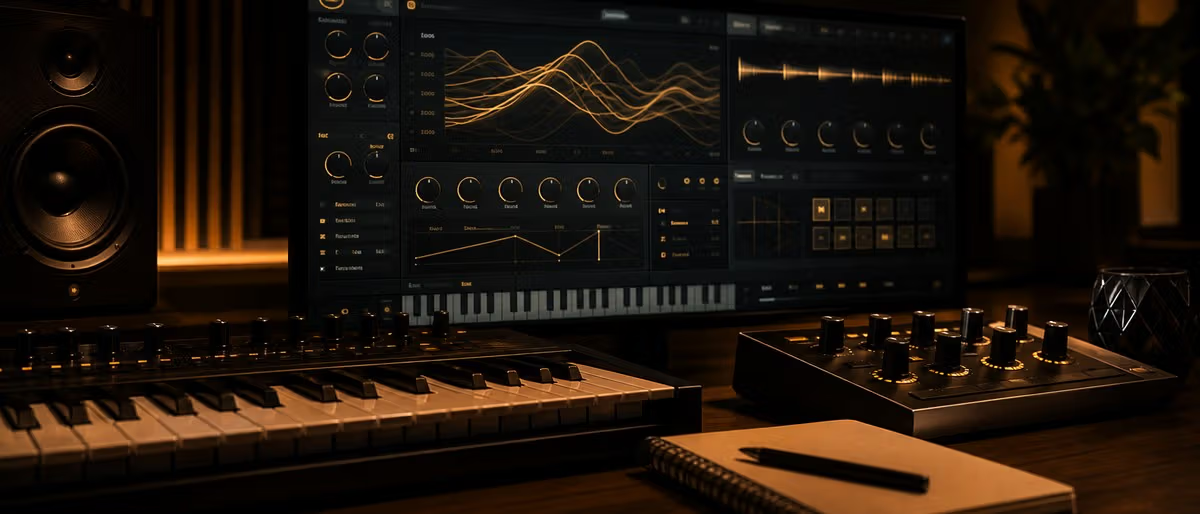
Syndesis Types Every Producer Moet Know
Wavetafle Synthesis: Serum, Vital, en Phase Plant
FM Syndesis: Beyond Presets
Granular Synthesis en Texture Design
Sound Layering: Bouwing Complex Timbres
Essential Processing Chains voor Sound Design
Syndesis Methods Compared
| Syndesis Type | Het beste voor | Key Synths | Leering Curve |
|---|---|---|---|
| Subtractive | Bassen, leads, pads, klassieke analoge tonen | Diva, TAL-U-NO, Monark (analog) | Laag — intuïtieve filter-gebaseerde workflow |
| Wavetable | Moderne bassen, evoluerende texturen, complexe leads | Serum, Vital, Phase Plant (wavetable) | Medium — wavetafle selection en modulation |
| FM | Metallieke klanken, bellen, elektrische piano's, agressieve bassen | FM8, Operator, Sytrus (FM) | Hoog — niet-lineaire parameterinteractie |
| Granular | Atmosferische texturen, ambient pads, experimenteel geluid | Portal, Quanta, Granulator II (granular) | Gemiddeld — afhankelijk van bronmateriaal |
| Additive | Organ tones, precise harmonic control, resyndesis | Razor, Harmor, Alchemy (additief) | High — requires understening of harmonics |
| Physical Modeling | Akoestische instrument-emulatie, getokkelde snaren, aangeslagen objecten | Chromaphone, Kaivo, Collision (fysiek model) | Gemiddeld — parameternamen sluiten aan op fysieke eigenschappen |
How to Design a Sound van Scratch
Learning path
Gerelateerde answer hubs
Sound Design Sound design: synthesis basics, bass design, presets, and usable sounds. Sound design is the process of creating or reshaping sounds with oscillators, samples, filters, envelopes, LFOs, effects, and layering. Beginners should learn one synth, build simple basses, leads, pads, and plucks, t... Free VST Plugins Free VST plugins: what to download first and how to use them safely. The best free VST plugin setup for most producers is one flexible synth, one EQ, one compressor, one reverb, one delay, and one metering tool. Vital or Surge XT can cover synthesis, TDR Nova can cover EQ, DC1A or TDR ...
Veelgestelde vragen
- What is de best synth voor learning sound design?
- Vital is de best starting point — it is free, has excellent visual feedback showing exactly what each parameter does to de sound, en covers wavetafle, FM, en basic subtractive synthesis in one interface. Serum is de industrie standard if je are willing to pay or gebruik Splice rent-to-own.
- How do I maak a bass sound die vertaals on small speakers?
- Layer a clean sub (sine wave below 100Hz) met a harmonically rich mid-bass (saturated saw or wavetafle, 100–500Hz). De sub provides low-end weight on full-range systems, while de harmonics van de mid layer are audible on telefoonspeakers en laptops. Saturation plugins like Decapitator or Saturn voeg harmonics to a sub zonder changing its fundamental.
- Is hardware synthesis worth it voor sound design?
- Hardware is worth it if je value de tactile experience of physical knobs en de character of analog circuits. But voor sound design flexibility, software is objectively more capafle — unlimited modulation routing, wavetafle import, built-in effects, en total recall. Most professioneel sound designers gebruik software as hun primary tool met hardware voor inspiratie.
- How do I vermijd presets sounding generic?
- Never gebruik a preset zonder modifying it. At minimum: change de filter cutoff, adjust de envelope, detune one oscillator slightly, en swap de reverb voor one die fits je mix. Better yet, gebruik presets as starting points to reverse-engineer how ze were made, then bouw je own version.
- What is de difference between an LFO en an envelope?
- An envelope triggers once per note en follows a defined shape (attack, decay, sustain, release) — it describes how a parameter changes van de moment je press a key to wanneer je release it. An LFO (Low Frequency Oscillator) cycles continuously at a set rate, creating repeating modulation like vibrato, tremolo, or filter wobble. Envelopes are one-shot, LFOs are looping.
- Hoe maak ik realistische sound effects?
- Start met a opname of de real thing (or something close to it), then process it met granular synthesis, pitch shifting, time stretching, en layering. A car engine kan become a spaceship. A creaking door kan become a monster. Foley-first, synthesis-second is de approach gebruikt by professioneel sound designers in film en games.
- Why does my sound design sound thin compared to professioneel tracks?
- Three common causes: lack of harmonic content (add saturatie or parallel distortion), lack of stereo breedte (use chorus, unison detune, or mid-side EQ), en lack of layering (professional sounds are often 2–4 layers occupying different frequency ranges). Also controleer je monitoring — sounds designed on koptelefoon often lack low-mid body.