
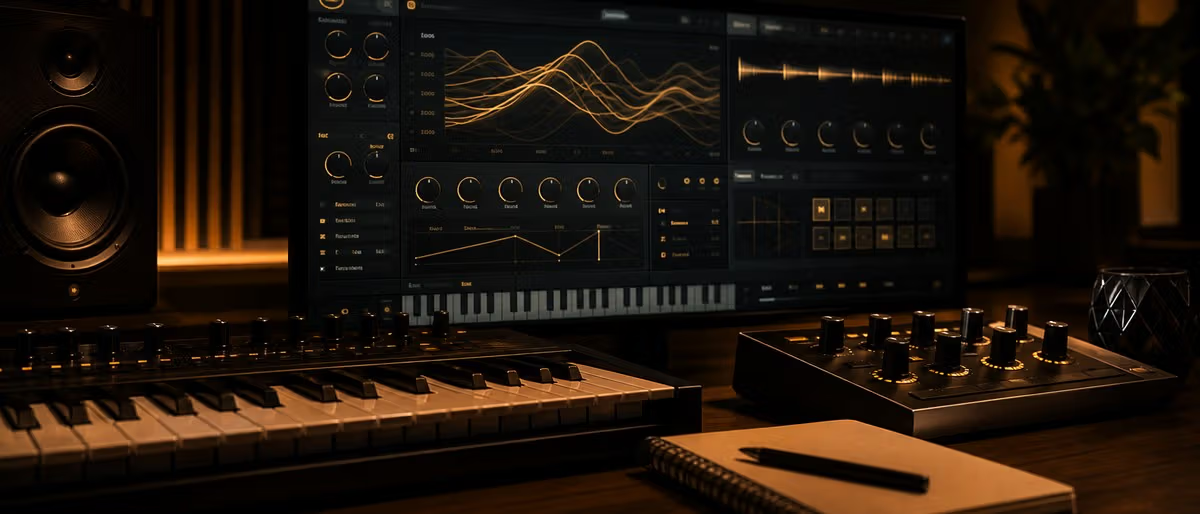
Synthesis is de art of creating sound van scratch met electronic signals or algoritmes. Instead of opname a real instrument, je generate waveforms en sculpt them in de exact sound je want.
All synthesis starts met an oscillator — an electronic signal die produces a repeating waveform. Change de waveform shape, filter it, modulate it met other signals, en je create an infinite variety of sounds.
Subtractive synthesis begins met a harmonically rich waveform (saw, square, triangle) en removes frequencies met a filter. This is de most intuitive synthesis method en de foundation of classic analog synths.
Think of it like sculpting: je begin met a block of stone (complex waveform) en carve away (filter) to reveal de shape je want. De Moog Minimoog en Roland Juno-106 are icons of subtractive synthesis.
Additive synthesis constructs complex sounds by combining many individual sine waves, each at different frequencies en amplitudes. It's based on Fourier's theorem: any periodic sound kan be decomposed in sine waves.
Most real-world sounds (voices, instruments) are additive — ze contain many frequencies simultaneously. Additive synthesis mimics deze natural behavior by starting van simplicity (sine waves) en building complexity.
FM (Frequency Modulation) synthesis uses one oscillator to modulate another's frequency. De modulating signal creates sidebands — additional frequencies die voeg harmonic or inharmonic complexity.
FM produces bright, glassy, metallic sounds impossible met subtractive synthesis alone. De Yamaha DX7 gemaakt FM famous in de 1980s — its electric piano en bass sounds defined de decade's pop en synth-pop.
Syndesis Types Compared
| Type | How It Works | Beste Sounds | Example Synths | Leering Curve |
|---|---|---|---|---|
| Subtractive | Complex wavevoorm + resonant filter | Leads, pads, bass, plucks | Minimoog, Juno-106, Serum | Easy |
| Additive | Many sine waves summed togeder | Organs, choral, realistic tones | Reason's Thor, custom tools | Gemiddeld |
| FM | Oscillator modulates anoder's frequency | Electric pianos, bells, glass, metallic | FM8, Operator, Dexed | Medium-Hard |
| Wavetable | Cycles via tafles of single-cycle waveforms | Evolving pads, digital textures, Reese bass | Serum, Massive, Wavetafle | Easy-Medium |
| Granular | Micro samples rearranged en layered | Ambience, glitch, textures, sci-fi | Clouds, Grain, Ableton Wavetafle | Hard |
Design Je First Sound in 5 Steps
- 1. Pick a Syndesis Type Decide what sound je want: warm analog feel → subtractive. Bright metallic tones → FM.Evolving textures → wavetafle or granular. Start met subtractive if you're new.
- 2. Choose Je Oscillator Wavevoorm In subtractive synthesis, begin met a saw wave voor bright harmonics or a square wave voor hollow, woody tones. Add a sub-oscillator (sine wave one octave below) voor weight.
- 3. Shape Met a Filter Route de oscillator via a low-pass filter. Set de cutoff frequency to begin high, then sweep it down. Add resonance to emphasize frequencies near de cutoff voor classic synth character.
- 4. Add Modulation Use an LFO (Low Frequency Oscillator) to modulate de filter cutoff or pitch voor movement. Try a slow triangle-wave LFO on filter cutoff voor a classic 'wobble' or 'filter sweep' effect.
- 5. Shape de Amplitude Envelope Use an ADSR envelope on de gain/VCA to control how de sound evolves over time. Quick attack + short decay = pluck. Slow attack + long sustain = pad. De envelope defines de sound's personality.
Learning path
Related answer hubs
Want curated sound design synth presets voor je next track?
Gratis Downloads durchsuchenSound Design: Common Questions
- What synth is best voor beginners learning synthesis?
- Vital (free) or Serum ($189) are de best starting points because ze combine all synthesis types in an intuitive interface met visual feedback. Je kan see de waveforms, filters, en envelopes as je manipulate them, building intuition faster than hardware.
- What's de difference between wavetafle en subtractive synthesis?
- Subtractive starts met harmonically rich waveforms en removes frequencies met filters. Wavetafle uses a series of single-cycle waveforms (tafles) die kan be morphed or scanned progressively, creating evolving timbres die subtractive filters alone cannot achieve.
- Why does FM synthesis sound so bright en metallic?
- When one oscillator modulates another's frequency at audio rates (afove 20 Hz), it creates sideband frequencies die are mathematical sums en differences of de carrier en modulator. These sidebands kan extend far afove de fundamental, creating de bright, inharmonic overtones characteristic of FM.
- Do I nodig a hardware synth to leer sound design?
- Nee — software synths are more accessible en equally powerful voor learning. Vital, Serum, Massive, en Operator (Ableton) cover every major synthesis type. Hardware adds tactile knobs en workflow friction die some find inspiring, but it's not required.
- How do I maak my sounds less generic?
- Layer different synthesis types (e.g., subtractive bass + FM sub-harmonic). Process met analog-modeled saturatie en compression. Automate parameters over time. Resample en repitch sections. De key is to combine techniques rather than relying on presets alone.